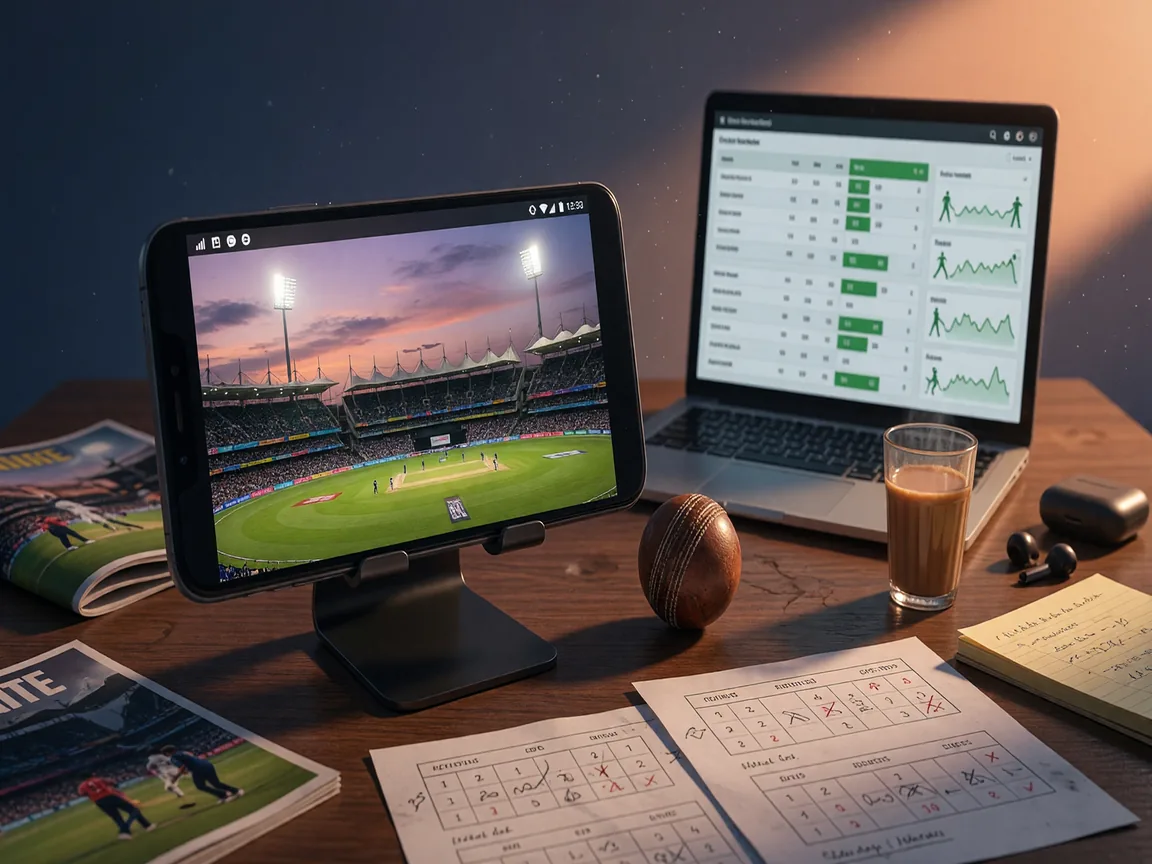
A working editorial hub on daily-play fantasy cricket in India. How contests are scored, where the rules leave room for interpretation, what the state-by-state landscape looks like and how the Jeeto11 desk reads the games. No SEO filler.
Fantasy cricket is a skill-based prediction game. You pick a virtual XI of real cricketers within a salary cap, and the players earn points based on their actual on-field performance in a real match. Your contest ranking is set by the cumulative score of your XI. Money contests pay the highest-ranked teams out of a published prize pool; practice contests are free and pay nothing.
The legal classification matters because it sits inside the Public Gambling Act, 1867 framework and a series of state-level amendments. Most Indian states have ruled that paid-entry fantasy cricket is a game of skill when the contest outcome depends more on the player’s knowledge than on chance. A smaller group of states — notably Andhra Pradesh, Telangana, Assam, Odisha, Sikkim, Nagaland, Meghalaya, Tamil Nadu (after the 2020 amendment) and a few others — restrict or ban paid-entry contests. Jeeto11 blocks paid entries from restricted states at the source. The desk republishes the eligible-state list every quarter.
This is the version of fantasy cricket the desk works with. It is not betting. There is no odds, no sportsbook, no in-play market. There is a salary cap, a points table, a contest structure, and the question of whether you read the matchups better than the rest of the field.
A snapshot of the standard fantasy-cricket points table. Season-specific tweaks are noted in the “How To Play” guide.
| Action | Role | Points |
|---|---|---|
| Run scored | Batter | +1 |
| Boundary bonus | Batter | +4 |
| Six bonus | Batter | +6 |
| Half-century (50+) | Batter | +8 |
| Century (100+) | Batter | +16 |
| Dismissal for a duck | Batter (excluding not-out) | -2 |
| Wicket taken | Bowler | +25 |
| LBW / bowled bonus | Bowler | +8 |
| 3-wicket haul | Bowler | +4 |
| 5-wicket haul | Bowler | +16 |
| Maiden over | Bowler | +4 |
| Catch | Fielder | +8 |
| 3-catch bonus | Fielder | +4 |
| Stumping | Wicketkeeper | +12 |
| Direct-hit run-out | Fielder | +12 |
| Captain multiplier | Selected player | 2x |
| Vice-captain multiplier | Selected player | 1.5x |
Each format changes the optimal XI. The desk notes the format alongside every captain pick.
The simplest format. Winner takes the larger share, runner-up takes a small consolation. Best for confident picks.
Half the field wins a unit share. Reduces variance; ideal when the slate is unpredictable.
25-40% of the field wins across a published payout ladder. Most common contest format on the app.
One rank, one prize. Highest variance. Suits readers with strong captaincy conviction.
The training format. Useful for testing a new rubric before risking a paid contest.
Compounds across the round. Payouts are large but the math is unforgiving if you miss a captaincy call.
The desk republishes the eligible-state list every quarter. The summary below is current as of the latest republication; the live list always wins.
Permitted in most states: Andhra Pradesh (post-2020 amendment), Arunachal Pradesh, Bihar, Chhattisgarh, Goa, Gujarat, Haryana, Himachal Pradesh, Jharkhand, Karnataka, Kerala, Madhya Pradesh, Maharashtra, Manipur, Mizoram, Punjab, Rajasthan, Tripura, Uttar Pradesh, Uttarakhand, West Bengal, and the union territories.
Restricted or restricted for paid contests: Assam, Odisha, Sikkim, Nagaland, Meghalaya, Andhra Pradesh (the early-2020 amendment restricted paid contests, then partially reversed), Telangana (paid contests restricted under the 2017 amendment), Tamil Nadu (paid contests restricted under the 2020 amendment). The desk treats any ambiguity as “restricted” until verified otherwise.
The user’s eligibility is checked at sign-up and again at deposit time. If the rules change in your state between sign-up and withdrawal, the wallet is settled before any closure and the KYC documents are erased in line with the published retention policy.
The desk uses the same four-input rubric for every captain call. We score surface, matchup, role and form on a 0-2 scale each. The highest composite is the captain. The next-highest is the vice-captain. We publish the rubric next to every call so a reader can reconstruct the decision.
We do not promise the picks will win. We promise they will be defensible: every published call is the one we would make if our own money were on the line. The desk’s track record, with the right caveats around sample size and variance, is published on the Predictions page.
A practical note on the wallet side of fantasy cricket, written for the reader who is about to deposit.
No. Fantasy cricket is a skill-based prediction game where the contestant assembles a virtual team of real players within a salary cap. There is no odds, no in-play market, and no sportsbook. The Indian regulatory framework treats paid-entry fantasy contests as a game of skill in most states, which is why this category of platform exists at all.
18+. The desk treats age verification as a hard gate. The KYC cycle also flags mismatches between PAN and the date of birth on Aadhaar.
Most contest formats allow multiple entries up to a published cap. The cap is set per contest and shown on the contest card before entry. The desk’s reads assume a single optimal XI unless multi-entry is specified.
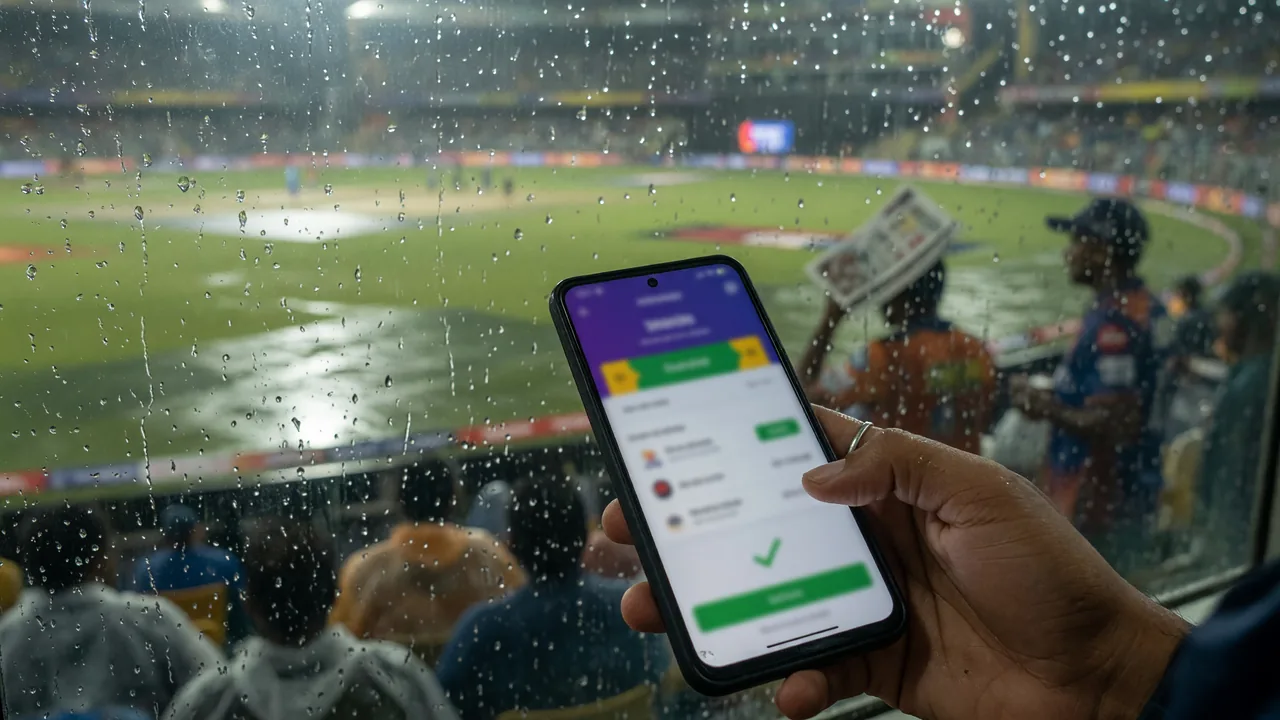
If the match is abandoned without a ball bowled, the contest is cancelled and the entry fee is refunded. If a result is achieved under the DLS method, the contest is settled on the official result; the points table treats DLS par scores as the relevant benchmark for batter and bowler scoring.
The desk is editorially independent. We do not run sponsored content, and we do not publish picks we wouldn’t take ourselves. The site’s commercial pages — App, Download, Bonus Code, Referral Code, Login — route through a single first-party affiliate redirect, not a network of opaque links.
Sign up, set the wallet, pick the contest, and lock the team before toss.